
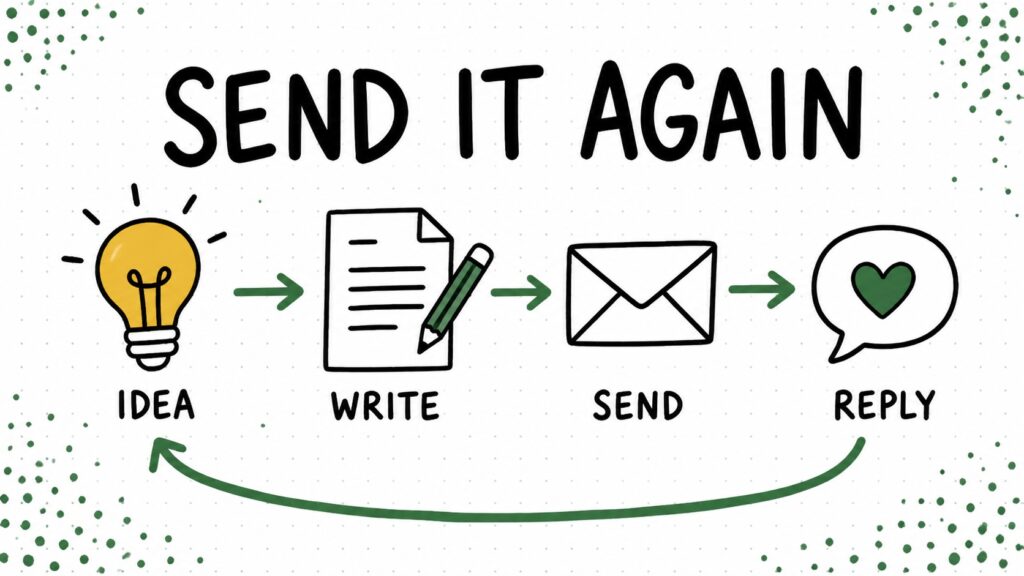
In our July 2026 Create & Go relaunch audit, we had 16,587 email subscribers.
By that July audit, we had sent two broadcasts that year.
That is a slightly embarrassing way to learn that having a newsletter and publishing a newsletter are different activities.
The software was still there. So were the subscribers. What had gone missing was the habit of showing up with something worth sending.
If you want to know how to start a newsletter, the setup is fairly simple: decide who it is for, make a specific promise, choose an email platform, build one signup page, write a welcome email, and send the first issue.
But there is one more step most guides leave until the end: put the second send on your calendar before the first one goes out.
Your logo will not create momentum. Your newsletter name will not climb out of bed and write issue two. A small promise you can keep has a fighting chance.
The short version: Start with one reader, one recurring problem, and one useful kind of email. Build the smallest signup path that works. Plan how new readers will receive a welcome email. Then send one real issue and repeat it before you redesign anything.
Start with the promise, not the name
A newsletter name can be fun. It can also occupy an entire afternoon before you have written a sentence anyone can subscribe to.
Naming feels productive because the blank document becomes a project. There is now a title, maybe a flag emoji, and perhaps a suspiciously thorough Notion board. Unfortunately, your future reader is still wondering what will arrive in their inbox.
Write this sentence first:
Every [frequency], I send [specific kind of help] to [specific person] so they can [useful result].
For example:
- Every Friday, I send one practical lesson to new food bloggers so they can grow traffic without publishing every day.
- Twice a month, I break down one reader’s welcome sequence so independent consultants can write better follow-up emails.
- On Sundays, I share one field note from building a small creative business for people who are tired of advice written from the victory parade.
The sentence is not necessarily your homepage copy. It is a test.
Can a stranger tell whether the newsletter is for them? Can you imagine writing ten issues without performing a minor archaeological dig for ideas? Does the promised result matter enough to justify another email?
If the answer is no, the name is not the problem yet.
Open a blank note and write ten possible subject lines for future issues. If the ideas arrive quickly and all help the same kind of reader, the premise has some life in it. If issue four is already “five quotes I liked this week,” narrow the promise before buying a domain.
Choose a format small enough to survive a busy week
New newsletters are often designed for the writer’s imaginary best week: the morning routine is immaculate, research takes exactly 45 minutes, and nobody needs the car serviced.
Your format should be built for a fairly ordinary Thursday.
That does not mean the newsletter must be shallow. It means the container should help you decide what belongs in it.
| Simplest start One useful idea | Curated field notes | Progress report | Answer one question | Weekly digest | |
|---|---|---|---|---|---|
| What the reader gets | A story, lesson, and practical next step | A few links with original commentary | What you tried, what happened, and what changes next | A thoughtful response to a real reader problem | New posts, tools, offers, and updates |
| Best when you… | Teach through experience and want a simple recurring structure | Read widely and can explain why each resource matters | Are building something readers want to follow in public | Already receive useful questions from clients, students, or followers | Publish enough elsewhere to make a digest genuinely useful |
Choose one primary container. Variety can live inside it without making every issue a new publication.
Pick one primary format. You can occasionally include a book, a joke, a poll, or a picture of the thing that went wrong. Those extras should make the issue more human, not force you to operate a tiny Sunday newspaper by yourself.
James Clear’s 3-2-1 newsletter is a useful format study because the promise is obvious and repeatable: three ideas, two quotes, and one question. You do not need to borrow the numbers. Borrow the discipline of making the reader’s expectation easy to understand.
You can see how consistently the format is applied in the 3-2-1 archive.
The strongest Create & Go emails have often followed a simple path: a real scene, an honest admission, the mechanism underneath it, and one useful invitation. “What I learned in jail” built its lesson around a concrete experience.
Specificity did the heavy lifting.
Pick a newsletter platform you can leave
The platform matters, but it does not deserve the first three weeks of the project.
At minimum, your email service should let you:
- Create a signup form or landing page.
- Send a one-time broadcast.
- Send a welcome email, with automation available on the plan you choose.
- Tag or segment subscribers when you need to.
- Export your subscriber list in a common format.
- See basic delivery, open, click, and unsubscribe data.
Our Kit recommendation includes an affiliate link. If you buy through it, we may earn a commission.
We use and recommend Kit, which was built around creators and publishers. As of November 5, 2026, Kit’s Free plan includes up to 10,000 subscribers, forms, landing pages, and broadcasts. Automated email sequences and Visual Automations require a paid plan. Check the current Free plan details before budgeting for an automated welcome email. Our Kit review covers the deeper tradeoffs.
Other tools can work. The important question is not which dashboard has the nicest gradient this month. Ask whether the tool supports the newsletter you have actually planned, whether the price still makes sense if the list grows, and whether you can export your audience if you decide to move.
Build one clean path from discovery to signup
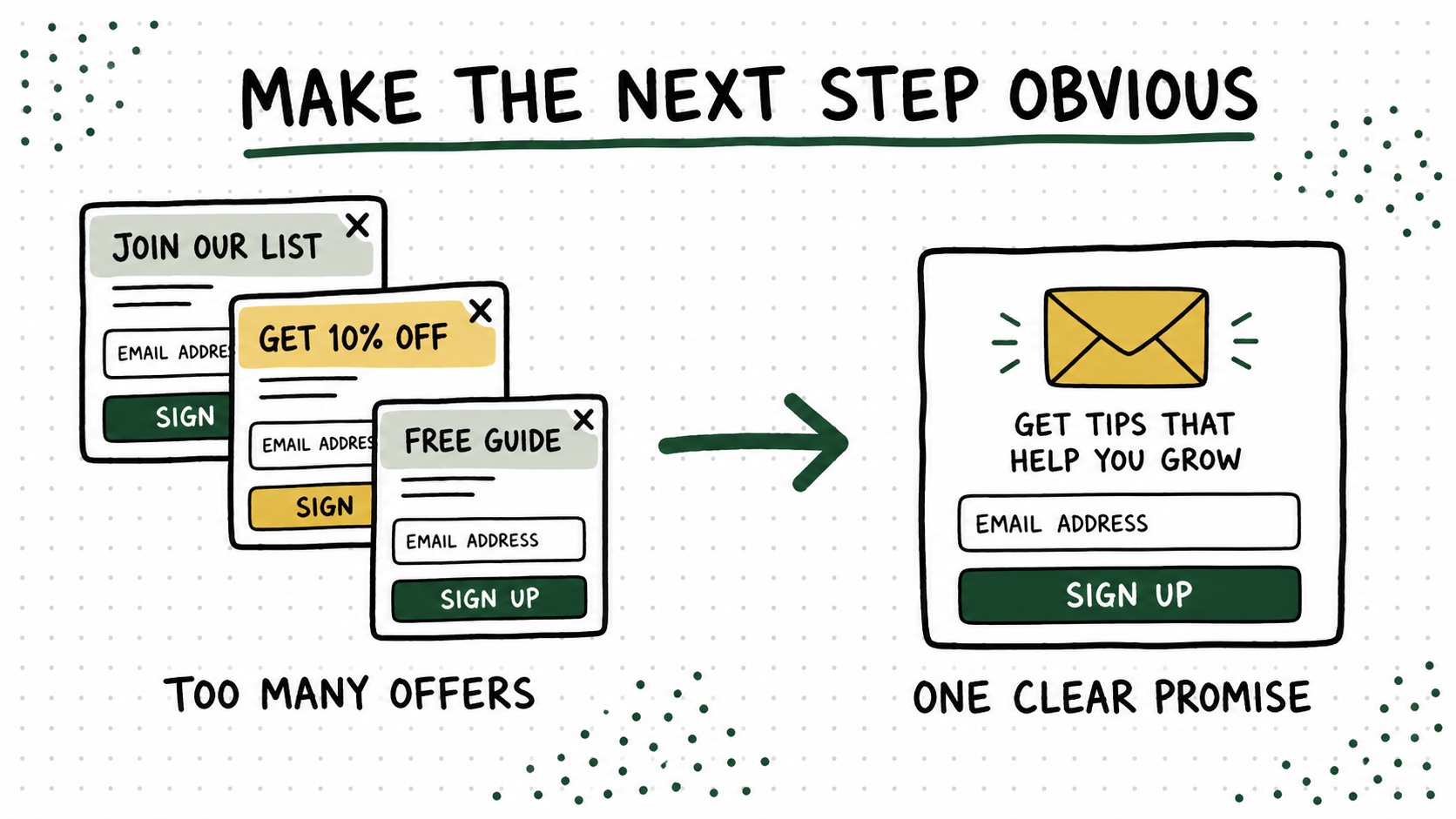
You do not need six lead magnets to start a newsletter. You need one place where the right reader understands the exchange.
A useful newsletter landing page answers four questions:
- Who is this for?
- What will I receive?
- How often will it arrive?
- Why should I trust you to make it worth opening?
Put the email field near that promise. If you have a strong example issue, show it. If you have proof—reader replies, experience, or a real result—use the most relevant piece rather than a rotating wall of compliments.
Then connect discovery to the page. This is the practical next step in building an audience you own: readers need a direct path back to you.
Your blog can place a relevant invitation inside or after articles. Your social profiles can point to the newsletter instead of a menu containing 14 links. A guest appearance can lead to a page written for the people who just heard you. The signup path should feel like the next chapter of the same conversation, not an unrelated request for access to someone’s inbox.
Our guide to building an email list goes deeper on subscriber growth. At this stage, you only need the first working door.
Write the welcome email before the first issue
The welcome email is the moment when interest becomes a relationship.
Do not spend it apologizing for the email or reciting your biography from childhood onward. Help the subscriber understand what they joined and give them something useful immediately.
A simple welcome email can include:
- A warm confirmation that they are in the right place.
- The newsletter promise and normal sending rhythm.
- One excellent article, tool, or lesson to begin with.
- A question they can reply to.
The reply question matters more than it looks.
Ask something you genuinely want to know: “What are you trying to finish right now?” is better than “Any thoughts?” A useful reply can teach you the language readers use, reveal the next issue, and remind the subscriber that a person is on the other side of the address.
Replies give you direct evidence of what a reader wants. They are not a guarantee of inbox placement, and they do not replace proper sending-domain setup or permission to email someone. I would ask even without a deliverability benefit. A newsletter written only from analytics gradually becomes a newsletter written for a spreadsheet.
End the welcome email with one sentence: “Hit reply and tell me ___.” Make the blank specific enough that a tired person can answer it in one line. Then read every response before outlining issue two.
Make that welcome message work on the plan you actually have. For a straightforward automated welcome in Kit, connect your Form or Landing Page to a welcome Sequence through an active Visual Automation. Writing the Sequence alone does not enroll subscribers. On the Free plan, start with a clear confirmation message and a manual welcome process you can maintain, or choose a paid plan before promising instant automated delivery. Kit’s setup guide explains the connection.
For a food-blog newsletter, a first welcome could say: “Every Friday I’ll send one practical lesson for growing your food blog. Start with the recipe-post checklist below. What is the one part of your blog you’re trying to improve this month?” That is an illustrative example, not a real reader message. Test the entire signup path with your own address: confirm the subscription, check the delivery, open the linked resource, and verify that the unsubscribe control works.
Write the first issue like an email, not a term paper
Your first issue does not need to explain your complete worldview.
Choose one problem close to the newsletter’s promise. Start with a scene, question, observation, or result that gives the reader a reason to care. Teach the useful part. Then offer one next step.
Before sending, check the basics:
- The subject line makes a clear or intriguing promise without pretending the email contains state secrets.
- The opening earns attention quickly.
- The body is easy to scan on a phone.
- There is one main point.
- Links go where the copy says they go.
- The email includes accurate sender information, a valid postal address where required, and a working unsubscribe link. Only email people who agreed to receive this newsletter; do not buy a list.
- You sent a test to yourself and looked at the actual test.
One main point does not mean three tiny paragraphs followed by “That’s the whole system.” A useful email can wander into a story, acknowledge a complication, share someone else’s smart idea, and still return to one central lesson. The reader should feel guided, not processed.
If you use AI to help with a draft, keep the specific detail or relevant exception that only you can contribute.
Schedule the second send before the first one leaves
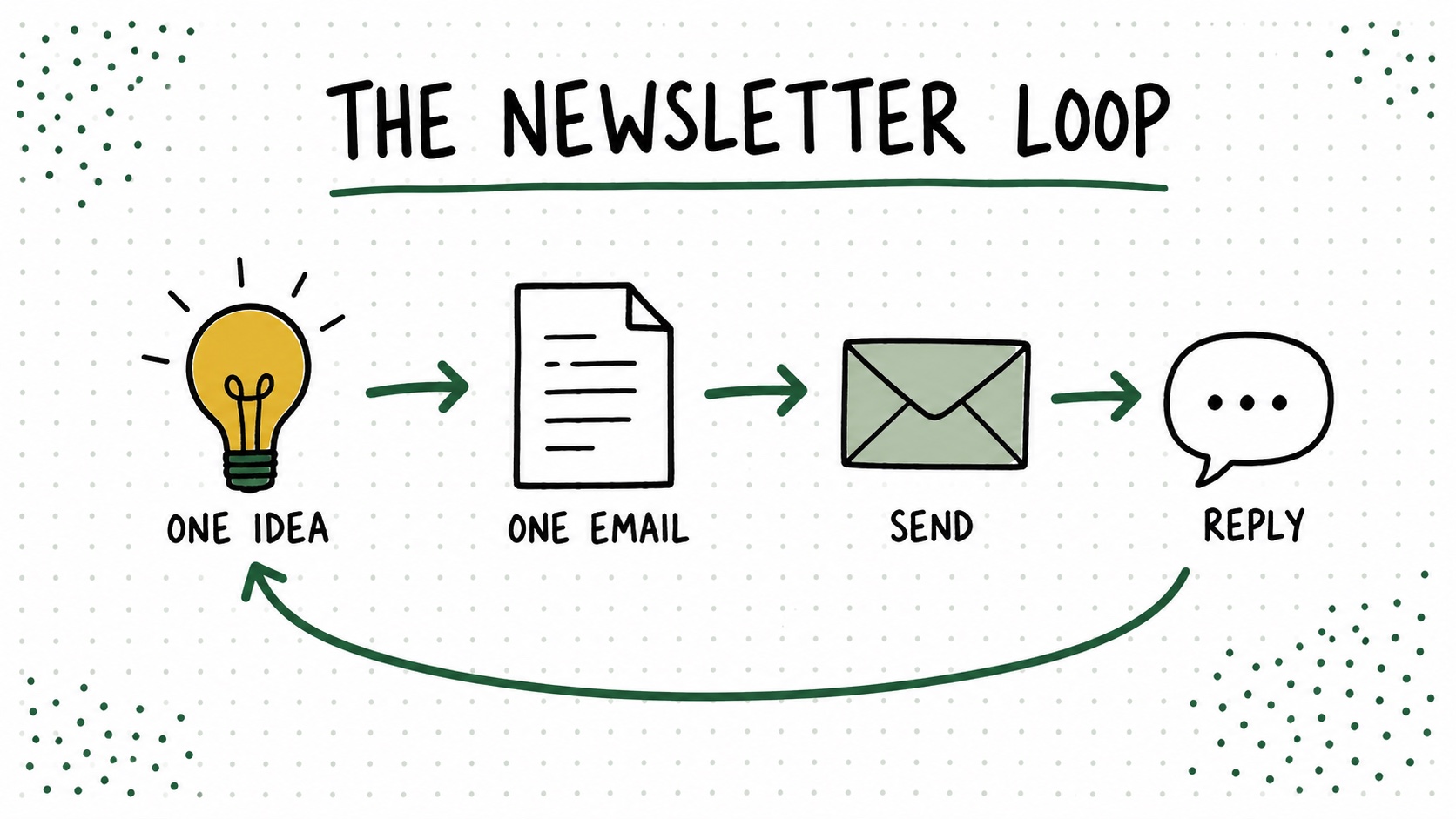
The first issue has novelty behind it. The second issue is where the newsletter begins.
Choose a cadence you can maintain for eight weeks. Weekly is easy for readers to remember, but every other week is much better than a weekly promise followed by a six-week disappearance and a subject line that begins “It’s been a while…”
Put the next date on your calendar. Add a rough topic. Decide when the draft must exist, not only when the email must be sent.
Then create a small idea capture system. Save reader questions, sentences from your work, mistakes, results, useful links, and moments that made you change your mind. You are not trying to build a content refinery. You are leaving ingredients where your future self can find them.
Oliver Burkeman’s Four Thousand Weeks is useful here because it refuses the fantasy that the right productivity system will eventually make time unlimited. Your newsletter has to fit inside a finite life. A sustainable cadence is not evidence that you lack ambition. It is evidence that you have met a calendar.
A newsletter is a promise made repeatedly. Pick a promise your real week can keep.
Grow by making the return worthwhile
Subscriber growth matters. A list that never meets anyone new eventually becomes a reunion committee.
But growth works better when the newsletter itself creates reasons to return and share.
Publish useful articles that naturally lead to the newsletter. Mention it when you teach on a podcast, video, or social platform. Create one genuinely helpful free resource when readers need more than the newsletter promise alone. Collaborate with people who serve the same kind of reader from a different angle.
Then make each issue good enough that forwarding it feels like helping a friend.
You can also ask for the share. A short line—“If this helped, send it to the person currently naming a newsletter instead of writing one”—is enough. No six-button referral casino required.
Jay Clouse’s PARTS framework is helpful because it separates platforms that attract attention from the systems that build trust and create revenue. A social post does not have to perform every job. Let it introduce the idea. Let the landing page make the promise. Let the newsletter deepen the relationship over time.
Measure signs of trust, not only opens
Open rates are useful but imperfect. Privacy protections can inflate them, and a clever subject line can win an open without earning much trust afterward.
Watch a small group of signals together:
- Delivery and bounce data: Is the email reaching healthy addresses?
- Clicks: Did readers act on the main invitation when the issue contained one?
- Replies: Did the email create a real conversation?
- Unsubscribes and spam complaints: Did the promise and the email match?
- Conversions: Did the newsletter help the right reader take a meaningful next step?
- Your ability to send again: Can you keep making this without resenting the small media company you accidentally invented?
Our personal-story emails have sometimes earned unusually strong open rates. Our March 7, 2024 email, “What I learned in jail,” recorded a 61.95% open rate across 22,460 recipients in the archived Kit report. That number does not prove that jail is an email strategy, which is fortunate.
That report records an outcome; it does not isolate the story as the cause, and privacy protections affect reported opens. The editorial lesson is more modest: a specific human story gives a familiar principle a concrete setting. The story still needs to lead somewhere useful. Vulnerability without a lesson is a diary entry sent to 22,000 people, which sounds stressful for everyone.
Common newsletter mistakes to avoid
Waiting for the audience before practicing
Your first 30 subscribers are enough to learn whether the promise is clear and the format is sustainable. A small list is a rehearsal room with actual people in it.
Changing the concept every week
Repetition feels more obvious to the writer than the reader. Give a useful format time to become recognizable before replacing it because Wednesday felt boring.
Treating every email like a launch
If each issue contains a countdown, a bonus, and the emotional weather of a game-show finale, ordinary teaching starts to feel suspicious. Sell when you have something relevant to sell. Help when there is nothing to sell.
Curating links without adding judgment
A pile of links is a browser-history export. Tell readers why a resource matters, what you disagree with, or where to begin. Sharing the great insight of another creator builds trust when you do the editorial work around it.
Making the newsletter too large to continue
The eight-section masterpiece is impressive once. The useful email that arrives when promised has a chance to become part of someone’s week.
A simple newsletter launch checklist
Before you send, make sure you have:
- A one-sentence promise.
- A primary format and realistic cadence.
- An email platform with exportable subscriber data.
- One landing page or signup form.
- A welcome email with a useful starting point and reply question.
- A first issue built around one meaningful lesson.
- A test send checked on desktop and mobile.
- The second issue dated and roughly outlined.
That is enough to begin.
You can add a referral program, segments, sponsorships, custom templates, paid tiers, a tasteful collection of emojis, and an automation diagram that resembles municipal plumbing later.
First, prove that you can make and keep the promise.
Frequently Asked Questions
How much does it cost to start a newsletter?
You can start for free with several email platforms. Costs usually increase as your subscriber count grows or when you need advanced automation, segmentation, team access, or monetization features. Check current pricing against the list you expect to have—not the list your optimistic spreadsheet says you will have by next Thursday.
How often should I send a newsletter?
Choose the most frequent cadence you can maintain without lowering the usefulness of the email. Weekly is easy to remember and gives you faster feedback. Every other week is a sensible starting point if weekly would turn the newsletter into a recurring emergency.
Do I need a website before starting a newsletter?
No. Many newsletter platforms include a hosted landing page, so you can begin collecting subscribers and sending emails without a full website. A website becomes valuable as you build a permanent library of useful content, improve search visibility, and want more control over the reader journey.
What should my first newsletter be about?
Solve one problem that sits directly inside your newsletter promise. Choose something you have experienced, tested, taught, or can explain with real evidence. The first issue should demonstrate what future subscribers can expect, not introduce every topic you may cover for the rest of your life.
How do newsletters make money?
Newsletters can support products, services, memberships, affiliates, sponsorships, paid subscriptions, or an existing business. Monetization works best when the offer matches the reason readers subscribed. Start by earning attention and trust; then make the next paid step useful and unsurprising.
The first useful move
Open a note and finish this sentence:
Every ___, I send ___ to ___ so they can ___.
Then write ten issue ideas underneath it.
Write the promise. Write issue one. Put issue two on the calendar.
That is how the newsletter becomes real.
