
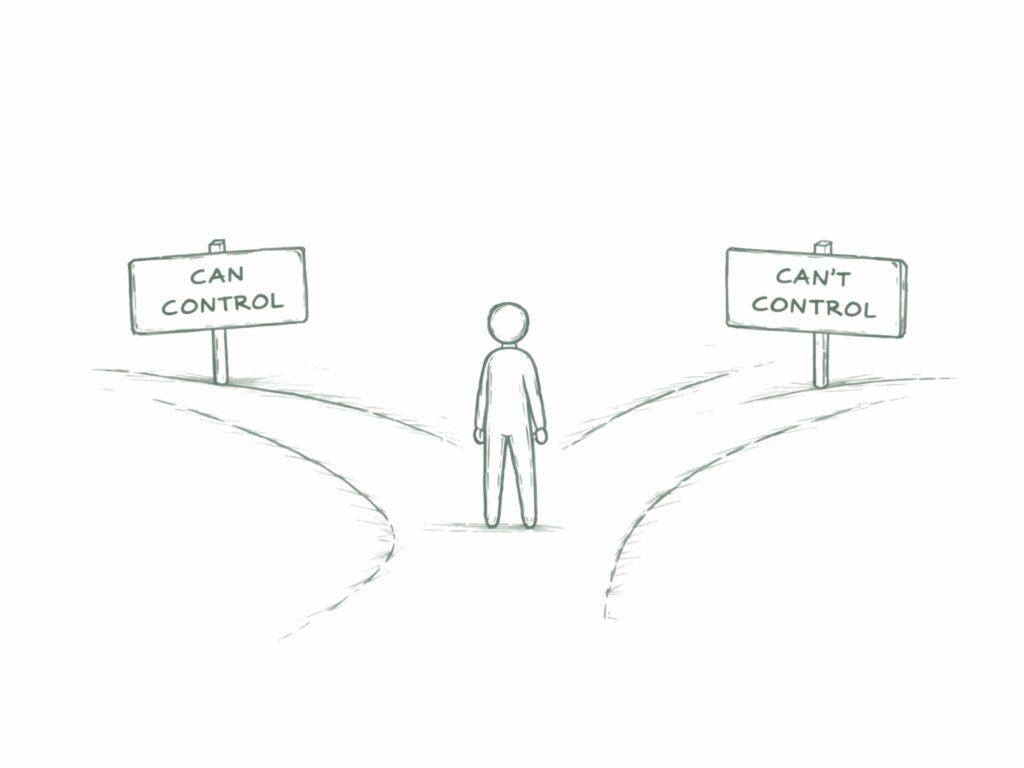
What You Can and Can’t Control (And Why Only the Next Action Is Ever Yours)
Most advice about “focusing on what you can control” has never really resonated with me.
When you are staring at a messy house, a broken routine, or a life that doesn’t look like the one in your head, it really does feel like those things are in your control. If you just tried harder, pushed more, organized better… you could flip the switch from “messy” to “clean,” from “stuck” to “on track.”
But that’s not how reality works.
Recently, between conversations with friends, some inspiration from books like The Genius Zone and Atomic Habits, and a lot of time alone with my thoughts, I realized something that has started to shift my perspective:
You never actually control outcomes. You only ever control the next most atomic action.
Once you see that, procrastination starts to fall apart, anxiety loses some of its grip, and the relief of focusing on what you can control becomes truly tangible.
But before we get there, we first have to talk about the illusion of control itself.
The Illusion of Control
We like to believe there are big levers we can pull.
- “I can fix my diet.”
- “I can get my house in order.”
- “I can finally get my life together.”
Those sound like things we can control because they feel close. They live inside our four walls, our calendar, our fridge. No one has to give us permission.
But if you look closer, each of those “controllable” things is just a label we slap on top of thousands of tiny, boring actions, plus a universe that we don’t control in the slightest.
- You don’t control having a “clean house.” You control picking up one piece of trash.
- You don’t control having a “healthy diet.” You control the next thing you put in your mouth.
- You don’t control “consistent movement.” You control standing up from the couch, putting on your shoes, and walking to the door.
That may sound ridiculous upon first read, but the more closely you look you realize it can’t be any other way.
Take, for example, cleaning your home. At any point, a tree can fall through your roof. You can get sick. The phone call comes that changes your day. Reality doesn’t care about your checklist.
So when we say things like, “I’m going to finally get my act together,” we’re actually trying to exert control over something we never actually had our hands on in the first place: the outcome.
What we really have control over is much smaller and actually much more powerful.
The Weighted Vest: Relief in Shrinking Your Circle
I was talking with my friend John recently about this idea of control. We started playing with the question: “What if I only tried to control what is actually controllable?”
The more we pulled on that thread, the more it started to feel like I was taking off a weighted vest I didn’t know I was wearing.
So much of my stress in my life has come from trying to shove entire outcomes around, to create certainty with willpower:
- Trying to control whether a project “succeeds” instead of whether I send the next email.
- Trying to control whether I “get healthy” instead of whether I eat one decent meal.
- Trying to control whether I “fix my life” instead of whether I make the next best decision possible.
When you stop pretending you can control the big thing, and you shrink your circle of responsibility down to one next action, your body feels the difference. There’s an unclenching of sorts. A loosening of your tightened grip over a reality that was never yours to grasp in the first place.
And when this happens, there is often a surge of energy or a wash of relief because now you’re playing a game you can actually win.
The House That Never “Gets Clean”
The conversation that really broke this open for me was with my sister Ivy.
We were talking about messy houses and messy lives, how overwhelming it feels when everything is out of order. And I said something that surprised myself as it came out of my mouth:
“You can’t actually control your house going from dirty to clean. You can only control the most atomic behavior toward that outcome.”
There is no button labeled “clean” that can be pushed to obtain a shiny, squeaky-clean home (as much as I wish there was).
There is only:
- Pick up this one piece of trash.
- Wash this one plate.
- Sweep this one section of the floor.
Each of those actions is boring, small, and completely within your control. And at some point, if you keep taking them, something weird happens:
At some point, you look up and say, “My house is clean.”
But you never actually controlled “dirty → clean” as a single move. The “clean house” was an emergent outcome — a side effect of thousands of tiny, controllable actions adding up over time.
The same is true for every area we care about: relationships, money, health, creative work, and so on.
You don’t change these categories. You change the next behavior. The new life is what emerges.
Why This Makes Procrastination Harder (In a Good Way)
Procrastination thrives on vague, impossible tasks:
- “Get in shape.”
- “Figure out my career.”
- “Finally start that project.”
Your brain looks at that and reasonably says, “Nope.”
It can’t see the edges. It doesn’t know where to start. So it shuts down, numbs out, scrolls, snacks, or spirals. It focused on what it CAN control by making the next behavior something comfortable. Many of us know this familiar behavior as what we call “self-sabotage”.
But once you accept that you never had control over something like “getting in shape” or “posting your next video,” only over putting your shoes on or sitting down to write the next script, the game changes.
You can’t procrastinate on “get in shape” or “posting the next video” because these aren’t actually actions at all (well, eventually “posting the next video” WILL be a step, but it is more importantly NOT the first step).
Instead, you CAN procrastinate on:
- “Standing up.”
- “Walking outside.”
- “Writing the first words.”
- “Hitting record.”
- etc.
This recognition allows you to see that you’re no longer avoiding a grand life overhaul. You’re avoiding a very simple behavior, and that’s a different conversation with yourself.
This is one of the reasons Atomic Habits hits so hard for so many people. James Clear keeps bringing you back to the most atomic, repeatable behavior — not the grand identity shift or glossy before-and-after photos. He continues to drive home the idea that outcomes are lagging indicators. They arrive late, if at all.
When you truly accept that, procrastination has less to feed on.
Funny enough, though I forgot about the prayer for a long time, this was actually something my mom constantly reminded us of, praying the Serenity Prayer with us as children.
Serenity, Courage, and the Wisdom to Know the Next Step
Baked into this small prayer that’s been repeated so many times over my life and in the meetings of many addiction programs is this exact realization:
God grant me the serenity
to accept the things I cannot change;
courage to change the things I can;
and wisdom to know the difference.
Most of us nod at that and move on.
But if you slow down and read it through the lens of “atomic actions,” it becomes a razor that can be applied to your life:
- “Things I cannot change” → outcomes, other people, the past, the future, the weather, the market, the algorithm, whether a tree falls through your roof (knock on wood).
- “Things I can” → whether I send this text, write this paragraph, pick up this piece of trash, or make this one honest choice in front of me.
- “Wisdom to know the difference” → the ability to see that “clean house,” “healthy body,” “successful business,” and “fixed life” all belong in the first category… and that the only thing that ever belonged in the second was the next smallest right action.
Once you start sorting your life that way, things get clearer. You stop arguing with reality about what already happened. You stop trying to mind-control other people into behaving differently. You stop waiting until you feel ready to overhaul everything.
Instead, you start asking a different question: “Given what is already true, what is the next thing that is actually mine to do?” (kind of a cute little rhyme too tbh lol)
The Unclenching: Letting Reality Run Itself
One of my favorite ideas from Oliver Burkeman is that “reality does not need you to operate it.”
Most of us walk around clenching our jaw tight, shoulders hunched, scrolling the news, doom-surfing, micromanaging things we have zero influence over, while the actual controllable things sit untouched right in front of us.
When you recognize that:
- You can’t control politics, but you can control how you treat the next person you meet.
- You can’t control the economy, but you can control how much you spend today and whether you learn one new skill this week.
- You can’t control whether your idea “takes off,” but you can control whether you publish the next post, email one person, or record one messy video.
…something in you relaxes.
You stop acting like the fool who believes they’re in charge of running the universe, and instead you start to become a person in a body, in a room, with JUST ONE next thing to do.
And that is enough.
How to Practice This in Real Life
Now, I’m sure this all sounds nice. But what does it look like on a Tuesday when your brain is loud, and your life is on fire? What does this look like in practice?
Here’s a simple way I’ve been practicing:
1. Name the thing you’re trying to control
Write it down in plain language:
- “Fix my finances.”
- “Lose 30 pounds.”
- “Finish my course.”
- “Get my house under control.”
Assume, for a moment, that none of those are actually controllable.
For a moment, just let that sink in.
2. Break it into the smallest next physical action
Ask: “If I couldn’t control that, what is the smallest, seemingly dumb or insufficient action I could absolutely control in the next five minutes?”
Examples:
- Open my banking app and look at one number.
- Fill one trash bag.
- Open the draft and write three sentences.
- Put my walking shoes by the door.
If it still feels vague, shrink it again until it is almost embarrassingly small.
You’d be surprised how making something smaller will give you the activation energy to start, which will give you the gift of momentum. Keep in mind a sailor does not set his sights on his destination and begin rowing towards it (this would make it a rowboat, not a sailboat, and would make him an idiot), instead, he sets his sails (the first step) and lets the wind do the rest.
3. Do just that — and nothing more
For the next few minutes, your entire universe is that one action.
Not your whole life. Not your five-year plan. Not your identity.
Just:
- Tap the app.
- Pick up the trash.
- Type the sentence.
- Tie the shoe.
When it’s done, acknowledge it.
Then ask again: “Given what is now true, what is the next thing that is actually mine to do?”
4. Let the outcome emerge on its own timeline
You don’t get to choose when “clean house,” “better health,” “successful business,” or “new career” shows up.
Your job is to:
- Keep shrinking your focus.
- Keep taking the next smallest controllable action.
- Keep refusing to carry outcomes that were never yours.
The rest is emergent.
The One Line I Keep Coming Back To
When I look across my highlights from different books, my conversations, my own messy attempts at changing my life, it all distills into something like this:
Life changes when you stop trying to control events, outcomes, and other people, and instead take radical responsibility for your own attention, your actions, and your responses — the only things that were ever really yours to control.
Everything else, the clean house, the healthier body, the finished project, the quieter mind, is just what happens when you practice that sentence in boring, unglamorous ways, one small action at a time.
You don’t have to fix your life today.
You just have to find the next thing that’s actually in your control — and do it.
Then, when you’re ready, do it again.
